https://dx.doi.org/10.24016/2026.v12.512
ORIGINAL ARTICLE
Can the Difficulties in Emotion Regulation Scale be even shorter? Development of the DERS-7
Pablo D.
Valencia1*, Anabel De la Rosa-Gómez2, Mariana
Cabral-Familiar3, Alejandrina Hernández-Posadas2, Lorena
A. Flores-Plata2
1 Coordinación
de Universidad Abierta y Educación Digital, Universidad Nacional Autónoma de
México, Mexico City, Mexico.
2 Facultad
de Estudios Superiores Iztacala, Universidad Nacional Autónoma de México,
Tlalnepantla, Mexico.
3 Portobello
Institute, Dublin, Ireland.
* Correspondence: pablo.valencia@ired.unam.mx
Received: February 01, 2026 | Revised: March 03, 2026 | Accepted: April 23, 2026 | Published Online: June 14, 2026.
CITE IT AS:
Valencia, P. D., De la Rosa-Gómez, A.,
Cabral-Familiar, M., Hernández-Posadas, A., & Flores-Plata, L. A. (2026). Can the Difficulties in Emotion
Regulation Scale be even shorter? Development of the DERS-7. Interacciones,
12, e512. https://doi.org/10.24016/2026.v12.512
ABSTRACT
Background: A 15-item version of the Difficulties in Emotion
Regulation Scale (DERS-15) has previously been tested in Latin America.
However, its factor structure remains unclear. Previous evidence suggests that,
after removing the Awareness item, the scale is essentially unidimensional.
Objective: This study aimed to shorten the DERS-15 and develop a
clearly unidimensional version that includes items from all the original
dimensions of the scale.
Methods: Two Mexican samples seeking psychological care were
analyzed (n₁ = 1,383; n₂ = 2,464). A series of exploratory factor
analyses was conducted to develop a shorter version of the scale. The resulting
7-item version, referred to as the DERS-7, was then evaluated through
confirmatory factor analysis, reliability estimation, measurement invariance
testing by sex, and associations with related variables.
Results: The DERS-7 showed excellent model fit in the
confirmatory phase (CFI = .99, RMSEA = .06) and adequate internal consistency
reliability (ω = .88). The scale was invariant between sexes, and its
associations with other variables were very similar to those observed for the
longer version.
Conclusions: The DERS-7 appears to be a promising alternative for
measuring emotional dysregulation when a global score is desired and
administering longer versions of the scale is not feasible.
Keywords: Emotion regulation, emotional
dysregulation, validation study, factor analysis, Mexico.
INTRODUCTION
Emotions comprise three interrelated elements:
cognitive, physiological, and behavioral. A change in one can potentially lead
to changes in the others (Reyes & Tena, 2016). Gross and Thompson (2007)
define emotional regulation as the process by which individuals influence the
emotions (positive and negative) experienced by themselves and others.
The contemporary functionalist perspective stresses
the important role of emotions in priming necessary behavioral responses,
fine-tuning decision-making, enhancing the memory of important events, and
facilitating interpersonal interactions (Beauchaine & Crowell, 2020).
However, they could also be detrimental when emotional responses occur at the
wrong intensity and time. This phenomenon is known as emotional dysregulation,
which is defined as the lack of ability to regulate emotional experiences, behavioral
responses, and expressions (verbal and nonverbal) in the presence of an
emotional stimulus. It is often the result of emotional vulnerability and the
inadequate selection of modulation strategies, leading to maladaptive responses
(Linehan et al., 2007). These maladaptive emotional responses are present in
various forms of psychopathologies, social difficulties, and mental disorders
(Gross & Thompson, 2007).
The Difficulties in Emotion Regulation Scale (DERS) (Gratz
& Roemer, 2004), has strong empirical support (Hallion et al., 2018; Kämpf
et al., 2023). The objective of this self-report scale is to evaluate emotional
difficulties through six factors: Non-acceptance, Goals, Impulse, Awareness,
Strategies, and Clarity. One of the main characteristics of the DERS is its
adaptability to different contexts and languages. In Colombia, Muñoz-Martínez
et al. (2016), based on an exploratory factor analysis, identified two
dimensions instead of six, resulting in a reduction of items from 36 to 15. The
factors were organized in the following manner: Factor 1 (composed of the
subdimensions Non-acceptance, Goals, Impulsivity, Strategies, and Clarity) and
Factor 2 (composed of the dimension Awareness).
Other brief versions, such as the DERS-16 (Bjureberg
et al., 2016), the DERS-SF (Kaufman et al., 2016), and the DERS-18 (Victor
& Klonsky, 2016), were developed primarily in English-speaking clinical and
community samples, typically retaining multi-factor structures by selecting
top-performing items from each dimension. More recently, an analysis of the
DERS-18 in Peruvian university students suggested that the scale is essentially
unidimensional when Awareness items—which consistently show poor factor loadings—are
removed (Blancas-Guillen et al., 2024). Despite the availability of these
alternatives, we chose to focus on refining the DERS-15 due to its linguistic
and cultural proximity to the Mexican context, and because it was already
established as a baseline assessment in ongoing national telepsychological
intervention trials. One challenge with this version (DERS-15) is that, despite
a previous study in the Mexican adult population, the results on its factorial
structure were inconclusive (De la Rosa-Gómez et al., 2021). Regarding the
Awareness dimension specifically, previous studies have consistently found that
its items tend to load poorly on the general dysregulation factor and often
behave as separate, weakly related component. This pattern has been attributed
to the distinct conceptual nature of Awareness—which refers to the ability to
attend to and acknowledge one’s emotions—as opposed to the other dimensions
that capture maladaptive responses to emotional distress (Bardeen et al., 2012;
Hallion et al., 2018; Muñoz-Martínez et al., 2016). As a result, the Awareness
subscale has been treated as psychometrically problematic and excluded in
several validated short versions of the scale. However, previous research
(Bardeen et al., 2012; Hallion et al., 2018) suggests that a DERS-14 (i.e., the
DERS-15 without the Awareness item) demonstrates essential unidimensionality,
implying a general factor and possible residual factors. Thus, it would be
feasible to construct a reduced version that adequately measures the general
dysregulation factor and can be explained by a single dimension, without
residual items (i.e., a strictly unidimensional scale) (Reise et al., 2013;
Slocum-Gori et al., 2009).
Furthermore, it is often assumed that psychometric
instruments assess equivalent constructs across women and men. As a result,
invariance testing is infrequently conducted, allowing potential biases in
research outcomes to remain undetected (Steyn & de Bruin, 2020). Therefore,
evaluating measurement invariance is essential to ensure that observed
differences reflect true variation in the underlying construct rather than
measurement bias. In the case of the DERS, evidence suggests the presence of
strict measurement invariance (Gómez-Simón et al., 2014; Gouveia et al., 2022;
Muñoz-Troncoso et al., 2024).
In view of the above, we examined DERS-15 and, based
on it, developed a briefer version that measured a single dimension of
emotional dysregulation. Specifically, (a) the dimensionality of the instrument
was examined; (b) a final brief version was evaluated in terms of its factor
structure and psychometric properties; (c) measurement invariance of this brief
version was analyzed in relation to sex; and (d) validity evidence based on
relations to anxiety and depression was obtained.
METHODS
Design
The present study was instrumental, as its purpose was
to examine the psychometric properties of a measure and to generate a brief
version of it (Ato et al., 2013).
Participants
Sample 1 (n = 1,383) had a mean age of 31.6 years (SD
= 9.94), ranging from 18 to 76 years, and Sample 2 (n = 2,464) had a mean age
of 32.4 years (SD = 9.98), ranging from 18 to 83 years (for complete
sociodemographic characteristics, see Table 1).
Table 1. Sociodemographic characteristics of the samples.
|
Characteristic |
Sample 1 |
Sample 2 |
|
|
(n = 1,383) |
(n = 2,464) |
|
Sex |
|
|
|
Women |
82.4% |
79.1% |
|
Men |
17.6% |
20.9% |
|
Marital Status |
|
|
|
Single |
53.3% |
57.8% |
|
Cohabiting |
14.6% |
14.2% |
|
Married |
19.2% |
15.6% |
|
Divorced/Separated |
9.2% |
10.9% |
|
Other |
3.7% |
1.5% |
|
Educational level |
|
|
|
High school |
21.4% |
32.0% |
|
Undergraduate |
58.7% |
50.8% |
|
Postgraduate |
10.1% |
13.2% |
|
Other |
9.8% |
4.0% |
|
Occupation |
|
|
|
Students |
27.3% |
26.6% |
|
Employed |
48.1% |
48.7% |
|
Unemployed |
9.9% |
14.0% |
|
Homemakers |
9.4% |
8.9% |
|
Other |
5.4% |
1.8% |
|
Place of residence |
|
|
|
Mexico City |
30.6% |
27.7% |
|
State of Mexico |
33.6% |
22.8% |
|
Other regions |
35.8% |
49.5% |
Instruments
Difficulties in Emotion Regulation Scale-15 (DERS-15; Muñoz-Martínez et al., 2016). The DERS-15 is an instrument
validated in Colombia, adapted from the original DERS-36 (Gratz & Roemer,
2004). It comprises 15 items grouped into two factors, with response options
ranging from 1 (almost never) to 5 (almost always). The first factor
encompasses items that in DERS-36 corresponded to the subscales of
Non-acceptance, Goals, Impulsivity, Strategies, and Clarity. Specifically,
items 1, 2, 3, 4, 5, 6, 7, 8, 9, 10, 11, 12, 13, and 14 belong to this factor.
Meanwhile, the second factor corresponds to the Awareness dimension and is
represented by a single item (item 15; i.e., "I am attentive to my
feelings"), which is reverse coded prior to scoring. Scores for each
factor are computed as the sum of the corresponding items, with higher total
scores indicating greater difficulties in emotion regulation. According to the
study by Muñoz-Martínez et al. (2016), it demonstrated good reliability (α
= .90), and evidence of its factorial validity in Mexican adults has also been
reported (De la Rosa-Gómez et al., 2021). In the Results section, we will
provide a detailed analysis of the psychometric properties of this measure in
the present sample.
Beck Depression Inventory II (BDI-II; Beck et al., 1996). It measures depression through 21 items.
Individuals can rate their responses on a scale of 0 to 3, resulting in total
scores ranging from 0 to 63. The BDI-II has shown strong psychometric
properties in Mexican populations. Previous studies reported adequate
reliability and validity across clinical and non-clinical samples (González et
al., 2015). More recent research has provided further support, demonstrating
high internal consistency (alpha greater than .90) as well as adequate
sensitivity and specificity in clinical samples (Rodríguez-Pérez et al., 2021).
In the current study, reliability was excellent (α = .92).
Beck Anxiety Inventory (BAI; Beck et al., 1988). This inventory was developed to evaluate the
severity of anxious symptoms. It is a self-administered scale with 21 items.
Each item is rated on a 4-point scale (0 = not at all, 3 = severely). The BAI
has demonstrated adequate psychometric properties in Mexican populations. Early
validation studies reported good internal consistency and convergent validity
across student, clinical, and community samples (Robles et al., 2001). More
recent evidence has confirmed its robustness, showing high internal consistency
(alpha greater than .90) and adequate construct validity, although some
variability in its factorial structure has been reported (Padrós Blázquez et
al., 2020). In the current study, its reliability was excellent (α = .93).
Procedure
Data collection for Sample 1 was conducted within the
framework of a telepsychological intervention study (De la Rosa-Gómez et al.,
2023). The DERS-15 was administered through a SurveyMonkey form as a baseline
measure prior to the assignment of users to the experimental groups.
Participants were recruited through social networks and institutional portals.
Data for Sample 2 were collected in a similar manner from another study that
sought to test two online psychological intervention modalities (De la Rosa-Gómez
et al., 2022). The dissemination process was conducted similarly to Sample 1,
and data were obtained through an online platform designed for the project,
which required user registration.
Analysis plan
First, an exploratory factor analysis (EFA) based on
polychoric correlations was conducted in Sample 1. The number of dimensions was
determined by an optimized parallel analysis (Timmerman & Lorenzo-Seva,
2011). We used the MORGANA method, an adaptation of the unweighted least
squares estimator that accounts for correlated residuals in an exploratory
framework (Ferrando et al., 2022). Subsequently, we identified the two items
with the highest residual correlation and selected only one item (the one with
the highest factor loading) for the next round of analyses. This procedure was
repeated until (a) the residual correlation identified could not be interpreted
in a straightforward manner, or (b) it fell below an absolute value of .30. The
.30 threshold was selected based on the criteria suggested by Ferrando et al.
(2022), who classify residual correlations between .20 and .30 as low doublets,
and values above .30 as medium or high doublets. Consequently, this cutoff was
used to systematically identify and remove items with significant redundant
variance not captured by the general factor. Special care was taken to include
items from all the original DERS dimensions.
Once a clear factor structure was established, we
tested in a new dataset (Sample 2). In this phase, we conducted a confirmatory
factor analysis with the WLSMV estimator. Model fit was examined with
approximate indices: comparative fit index (CFI), Tucker-Lewis
index (TLI), root-mean-square error of approximation (RMSEA), and standardized
root-mean-square residual (SRMR). Following Hu and Bentler's (1999) guidelines,
the following values were considered as evidence of good fit: CFI > .95, TLI
> .95, RMSEA < .06, SRMR < .08. If the model had an acceptable fit, we
proceeded to estimate internal consistency reliability using Green and Yang's
(2009) categorical omega. Next, measurement invariance was also examined. As
recommended for non-linear models, threshold invariance was tested, followed by
threshold and loadings invariance (Temme, 2006), using Wu and Estabrook's
(2016) method. Finally, associative evidence of validity was obtained from
Sample 2. Pearson correlations were calculated between the DERS scores and
measures of depression (BDI-II) and anxiety (BAI). Additionally, we estimated
the correlation (r) between the longer and shorter forms, and subsequently,
this value was later corrected (r′) for spurious correlation (Levy,
1967).
The EFA was conducted using FACTOR (version 12.04.01).
For CFA and measurement invariance, we used the packages lavaan (version
0.6-16) and semTools (version 0.5-6) implemented in R (version 4.3.0).
Ethical aspects
The study was approved by the Research Ethics
Committee of the Facultad de Estudios Superiores Iztacala of the Universidad
Nacional Autónoma de México (CE/FESI/082020/1363). Due to the nature of the
primary intervention studies, the data was not anonymized; however, access to
the databases was restricted to the principal investigator and two assistants.
Anonymized versions of the data were created for research purposes. In both
samples, informed consent was requested prior to data collection.
RESULTS
Item-Level Descriptive Statistics
Table 2 presents descriptive statistics of the DERS-15
items in Sample 1. Notably, the majority of items exhibit means around 3 (i.e.
the middle option). The lowest value was observed in item 13 (When I’m upset, I
lose control over my behaviors), while the largest one was that of item 7 (When
I’m upset, I have difficulty focusing on other things). Standard deviations
were similar across all items. Additionally, skewness values were all
reasonably close to zero. On the other hand, most kurtosis values were negative
and fell below -1, suggesting that the items had a platykurtic distribution.
Table 2 provides the percentages of response options.
Table 2. Item-Level Descriptive
Statistics of the DERS-15 (n = 1383).
|
Item |
M |
SD |
g₁ |
g₂ |
Responses to Each Option (%) |
||||
|
|
|
|
|
|
1 |
2 |
3 |
4 |
5 |
|
1. Tengo dificultad para encontrar el significado a mis sentimientos [I
have difficulty making sense out of my feelings]. |
3.06 |
1.22 |
0.05 |
-1.11 |
9 |
31 |
19 |
27 |
14 |
|
2. Estoy confundido(a) acerca de cómo me siento [I am confused about how
I feel]. |
3.15 |
1.23 |
-0.03 |
-1.17 |
8 |
30 |
17 |
29 |
16 |
|
3. Cuando estoy alterado(a), tengo dificultad para realizar el trabajo
[When I’m upset, I have difficulty getting work done]. |
3.41 |
1.24 |
-0.26 |
-1.13 |
6 |
24 |
16 |
30 |
23 |
|
4. Cuando estoy molesto(a), quedo fuera de control [When I’m upset, I
become out of control]. |
2.57 |
1.38 |
0.49 |
-1.06 |
27 |
31 |
13 |
16 |
13 |
|
5. Cuando estoy
alterado(a), creo que seguirá siendo así durante mucho tiempo [When I’m
upset, I believe that I will remain that way for a long time]. |
2.73 |
1.34 |
0.29 |
-1.17 |
21 |
31 |
14 |
21 |
13 |
|
6. Cuando estoy
alterado(a), creo que voy a terminar sintiéndome muy deprimido [When I’m
upset, I believe that I’ll end up feeling very depressed]. |
3.04 |
1.42 |
-0.01 |
-1.39 |
17 |
26 |
12 |
23 |
21 |
|
7. Cuando estoy
alterado(a), tengo dificultad para concentrarme en otras cosas [When I’m
upset, I have difficulty focusing on other things]. |
3.61 |
1.25 |
-0.45 |
-1.08 |
4 |
22 |
13 |
30 |
31 |
|
8. Cuando estoy alterado(a), me siento fuera de control [When I’m upset,
I feel out of control]. |
2.74 |
1.40 |
0.32 |
-1.21 |
23 |
30 |
14 |
17 |
16 |
|
9. Cuando estoy
alterado(a), me siento avergonzado de mí mismo por sentir de esa manera [When
I’m upset, I feel ashamed with myself for feeling that way]. |
3.00 |
1.44 |
0.06 |
-1.42 |
18 |
27 |
11 |
21 |
22 |
|
10. Cuando estoy alterado(a), yo tengo dificultades
concentrándome [When I’m upset, I have difficulty concentrating]. |
3.47 |
1.30 |
-0.34 |
-1.18 |
7 |
23 |
14 |
28 |
28 |
|
11. Cuando estoy alterado(a), tengo dificultades controlando mis
comportamientos [When I’m upset, I have difficulty controlling my behaviors]. |
2.75 |
1.36 |
0.34 |
-1.16 |
20 |
32 |
15 |
18 |
15 |
|
12. Cuando estoy alterado(a), creo que no hay nada que pueda hacer para
sentirme mejor [When I’m upset, I believe that there is nothing I can do to
make myself feel better]. |
2.88 |
1.37 |
0.21 |
-1.25 |
17 |
31 |
15 |
20 |
17 |
|
13. Cuando estoy alterado(a), pierdo el control sobre mis conductas [When
I’m upset, I lose control over my behaviours]. |
2.38 |
1.36 |
0.68 |
-0.83 |
34 |
30 |
11 |
14 |
11 |
|
14. Cuando estoy
alterado(a), encuentro difícil pensar en algo más [When I’m upset, I have
difficulty thinking about anything else]. |
3.33 |
1.31 |
-0.19 |
-1.25 |
8 |
26 |
14 |
27 |
24 |
|
15. Yo estoy atento a mis sentimientos [I am attentive to my feelings]. |
2.97 |
1.24 |
0.10 |
-1.08 |
12 |
30 |
20 |
25 |
13 |
Note. g₁ =
skewness. g₂ = kurtosis (zero centered). Response options are
as follows: 1 = almost never, 2 = sometimes, 3 = about half of the time, 4 =
most of the time, and 5 = almost always.
Exploratory Factor Analysis
Before conducting the EFA, the adequacy of the
correlation matrix was evaluated. The Kaiser-Meyer-Olkin (KMO) measure was .92,
and Bartlett’s test of sphericity was significant, χ²(105)
= 15843.7, p < .001, indicating that the data were suitable for factor
analysis. The parallel analysis suggested the extraction of a single factor.
When examining the factor solution, we observed that item 15 (corresponding to
the original Awareness dimension) had a factor loading close to zero (λ =
.01); therefore, we decided to discard it. In the next round of analysis, a
high residual correlation was found between items 1 and 2 (φ = .70, 95%
CI: [.66, .75]). Subsequent item eliminations were performed to address
redundancy within the original DERS dimensions. Based on the factor loadings,
we decided to retain item 1 and discard item 2. In the next round of analysis,
with 13 items, a high correlation was found between the residuals of items 7
and 10 (φ = .70, 95% CI: [.64, .76]), both representing the Goals dimension.
Consequently, item 10 was eliminated, and a new analysis was performed. This
pattern of redundancy within dimensions continued: a high residual correlation
was found for items 11 and 13 (φ = .63, 95% CI: [.60, .71]). In this case,
we decided to drop item 13 and redo the analysis. Once more, a high residual
correlation was observed, this time between items 4 and 8 (φ = .58, 95%
CI: [.53, .63]); item 8 was retained for the next analysis. The reanalysis,
which included 8 items, showed a moderate correlation between the residuals of
items 7 and 14 (φ = .34, 95% CI: [.30, .45]). Following the removal of
item 14, a final analysis was performed with the remaining 7 items, however,
the residual correlations identified did not meet our interpretability
criteria, so this was considered the final model. Table 3 provides the
polychoric correlations on which the described factor analysis was based.
Table 3. Inter-item polychoric
correlations of the DERS-15 (n = 1383).
|
Item |
1 |
2 |
3 |
4 |
5 |
6 |
7 |
8 |
9 |
10 |
11 |
12 |
13 |
14 |
15 |
|
1 |
— |
||||||||||||||
|
2 |
0.79 |
— |
|||||||||||||
|
3 |
0.45 |
0.48 |
— |
||||||||||||
|
4 |
0.38 |
0.37 |
0.50 |
— |
|||||||||||
|
5 |
0.44 |
0.44 |
0.55 |
0.65 |
— |
||||||||||
|
6 |
0.48 |
0.49 |
0.55 |
0.52 |
0.66 |
— |
|||||||||
|
7 |
0.45 |
0.43 |
0.75 |
0.54 |
0.59 |
0.65 |
— |
||||||||
|
8 |
0.41 |
0.38 |
0.54 |
0.81 |
0.68 |
0.58 |
0.64 |
— |
|||||||
|
9 |
0.43 |
0.42 |
0.50 |
0.48 |
0.56 |
0.59 |
0.56 |
0.60 |
— |
||||||
|
10 |
0.42 |
0.41 |
0.74 |
0.50 |
0.57 |
0.56 |
0.87 |
0.61 |
0.61 |
— |
|||||
|
11 |
0.42 |
0.39 |
0.50 |
0.75 |
0.63 |
0.52 |
0.54 |
0.78 |
0.57 |
0.56 |
— |
||||
|
12 |
0.52 |
0.48 |
0.58 |
0.56 |
0.69 |
0.67 |
0.60 |
0.65 |
0.60 |
0.60 |
0.66 |
— |
|||
|
13 |
0.41 |
0.37 |
0.46 |
0.79 |
0.62 |
0.50 |
0.50 |
0.78 |
0.54 |
0.50 |
0.86 |
0.65 |
— |
||
|
14 |
0.38 |
0.37 |
0.61 |
0.51 |
0.61 |
0.58 |
0.73 |
0.59 |
0.56 |
0.69 |
0.55 |
0.69 |
0.58 |
— |
|
|
15 |
-0.21 |
-0.15 |
0.04 |
-0.01 |
0.03 |
0.10 |
0.09 |
0.00 |
0.05 |
0.06 |
-0.03 |
0.01 |
-0.06 |
0.09 |
— |
Confirmatory Factor Analysis and Internal Consistency Reliability
The confirmatory factor analysis performed on Sample 2
(n = 2464) showed an adequate fit of the previously obtained 7-item model
(henceforth called DERS-7): χ²(14) = 140.67, p
< .001, CFI = .99, TLI = .99, RMSEA = .06, SRMR = .02. As shown in Figure 1,
the factor loadings were between .56 and .83. Likewise, the internal
consistency reliability was adequate (α = .87, ωcategorical
= .88).
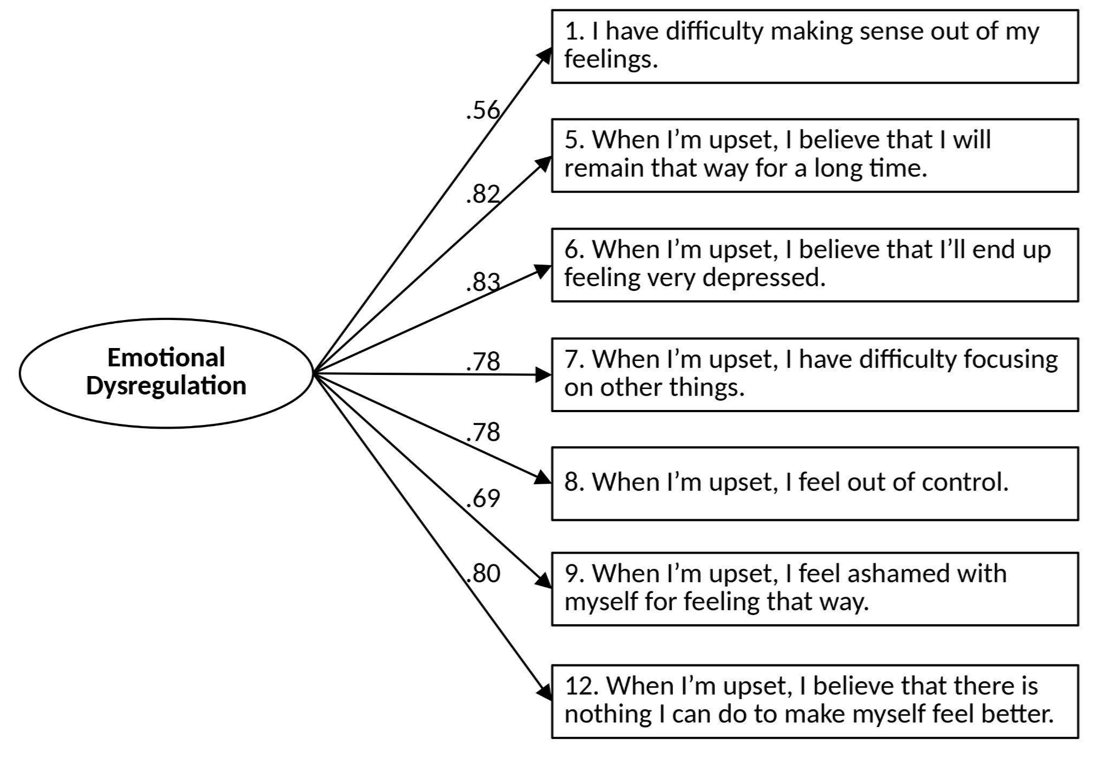
Figure 1. Factor Structure of the
DERS-7
Note. Residuals, thresholds, and intercepts are not presented to ease
interpretation.
Measurement Invariance
As shown in Table 4, both thresholds and factor
loadings were equivalent between men and women. Therefore, it is possible to
make valid comparisons between sexes using the DERS-7.
Table 4. Measurement invariance of the
DERS-7 by sex (n = 2464).
|
Model |
χ² |
df |
p |
CFI |
TLI |
RMSEA |
Δχ² |
Δdf |
p |
|
1. Configural (baseline) |
162.92 |
28 |
<.001 |
0.99 |
0.99 |
0.06 |
|||
|
2. Equal thresholds |
178.17 |
42 |
<.001 |
0.99 |
0.99 |
0.05 |
11.92 |
14 |
0.612 |
|
3. Equal thresholds and
loadings |
155.77 |
48 |
<.001 |
0.99 |
1.00 |
0.04 |
6.30 |
6 |
0.390 |
Note. Wu and Estabrook's (2016)
approach was followed.
Associative Validity Evidence
Both the DERS-7 and the DERS-14 (i.e., DERS-15 after
removing the Awareness item) were examined in relation to anxious and
depressive symptomatology. For anxiety, the correlations of the DERS-7 (r =
.54, 95% CI: [.51, .56]) were virtually identical to those of the DERS-14 (r =
.54, 95% CI: [.51, .57]). Similarly, correlations with depression were very similar
to the DERS-7 (r = .63, 95% CI: [.61, .66]) and the DERS-14 (r = .63, 95% CI:
[.60, .65]). Finally, the association between DERS-7 and DERS-14 was also
calculated by applying the correction for spurious correlation. The corrected
value indicated a strong association between both versions (r′ = .90, 95%
CI: [.90, .91]).
DISCUSSION
The present study examined the structure of the factor
of a short version of the DERS: the DERS-15. Results indicated that, apart from
the Awareness item, it was essentially unidimensional, however, it exhibited
some residual correlations. Based on this result, we were able to construct a
shorter 7-item version that retained the original scale’s psychometric
properties while delivering a clearer factor solution with no residual
correlations. Importantly, the final DERS-7 comprises items representing the
original domains of Non-acceptance, Goals, Impulse, Strategies, and Clarity,
thus preserving the conceptual scope of emotional dysregulation while achieving
a strictly unidimensional structure.
In the original study in which DERS-15 was proposed,
researchers identified two components that best explained the variance of the
data. One of these components assessed Dysregulation, while the other (composed
of only one item) measured Awareness (Muñoz-Martínez et al., 2016). However,
this structure did not obtain a good fit when it was subsequently tested in the
Mexican population (De la Rosa-Gómez et al., 2021). The data from the present
study allows us to understand the reason for this discrepancy. The
Dysregulation subscale does, in fact, measure a global dimension but also
exhibits a set of residual correlations. In other words, this subscale does not
present strict, but essential unidimensionality (Reise et al., 2013;
Slocum-Gori et al., 2009). To address this issue, we propose a reduced version
(DERS-7), which not only shortens the scale but also maintains items
representing all the original dimensions of the DERS (except for Awareness).
The Awareness dimension was excluded given its low factor loadings and weak
association with the general dysregulation factor, likely due to its distinct
conceptual emphasis on emotional attention rather than dysregulatory responses,
thereby improving factorial coherence.
The finding that the DERS is an essentially
unidimensional measure is consistent with those reported in other studies. For
example, Hallion et al. (2018) identified a bifactor structure in the DERS and
various short versions, which included a strong general factor and a set of
residual factors (excluding Awareness items). Similarly, the study by Mekawi et
al. (2021) also found support for a bifactor model, in which the general
dysregulation factor was stronger than the specific ones, after excluding Awareness.
Finally, Blancas-Guillen et al. (2024) reached a similar conclusion, and
recommended researchers calculate only an overall DERS score (excluding
Awareness items), emphasizing the limited utility of the specific dimensions.
Notably, all these studies underscore the necessity of excluding the Awareness
items when calculating an overall score, thus justifying their elimination in
our proposal. In this context, although bifactor models provide a useful
representation of the hierarchical structure of the DERS, the consistent
dominance of the general factor supports the use of more parsimonious
unidimensional approaches when the goal is to obtain a global score. Accordingly, DERS-7 can be treated as a
unidimensional measure of emotional dysregulation for scoring and
interpretation.
The item reduction process was guided by both
statistical and theoretical criteria. Statistically, items were removed when
they exhibited high residual correlations, indicating redundancy beyond the
general factor. In each case, the item with the highest factor loading was
retained. Theoretically, special care was taken to preserve items that captured
the core features of emotional dysregulation, ensuring that the resulting
scale-maintained content validity despite being brief. In this context,
although bifactor models provide a useful representation of the hierarchical
structure of the DERS, the consistent dominance of the general factor supports
the use of more parsimonious unidimensional approaches when the goal is to
obtain a global score. While this approach offers a more efficient and
psychometrically clean global estimate for screening, its primary disadvantage
is the loss of face-to-level granularity. Consequently, DERS-7 prioritizes the
assessment of general maladaptive reactivity over the ability to monitor
emotional states or identify specific regulatory profiles.
Limitations
The present study has several limitations that should
be acknowledged. First, the predominance of women, constituting approximately
80% of both samples. This imbalance may limit the generalizability of the
findings to men, particularly given evidence that emotional regulation
processes and their expression can vary by gender. Second, all the data
collected relied on self-report measures, we were unable to examine whether the
information extrapolated to the level of directly observable behaviors. Additionally,
the level of education in both samples, where most participants had university
or graduate degrees, may not accurately represent the Mexican educational
reality. Finally, the absence of a specific emotion regulation measure
prevented a direct assessment of convergent validity. Despite these
limitations, the present study does offer several strengths, such as the
assessment of individuals seeking psychological help, the use of two study
samples (one for construction and the other for replication), as well as
substantial sample sizes.
Conclusion
In the present study, a 15-item version of the DERS,
previously developed in the Colombian population, was used to generate an even
shorter version of the instrument. After excluding the Awareness dimension
item, the DERS-15 was reduced to a briefer 7-item version that maintained items
from the original five dimensions and presented a unidimensional structure.
This brief version can prove to be valuable in contexts where time constraints
or respondent fatigue, and a global estimate of emotional dysregulation is
needed using only a few items. Future studies should test the DERS-7 in other
populations and examine its performance.
ORCID
Pablo D.
Valencia: https://orcid.org/0000-0002-6809-1805
Anabel De
la Rosa-Gómez: https://orcid.org/0000-0002-3527-1500
Mariana
Cabral-Familiar: https://orcid.org/0009-0007-1143-7303
Alejandrina
Hernández-Posadas: https://orcid.org/0000-0001-5753-9785
Lorena A.
Flores-Plata: https://orcid.org/0000-0003-1306-0718
AUTHORS’
CONTRIBUTION
Pablo D. Valencia:
Conceptualization, Data Curation, Formal Analysis, Writing - Review &
Editing.
Anabel De la
Rosa-Gómez: Conceptualization, Writing - Review & Editing, Supervision,
Project administration, Funding acquisition.
Mariana
Cabral-Familiar: Writing - Original Draft.
Alejandrina
Hernández-Posadas: Writing - Original Draft.
Lorena A. Flores-Plata:
Writing - Original Draft.
FUNDING
SOURCE
This work was supported by both
the UNAM-PAPIIT Project (IT300721) and the former Mexican Consejo Nacional de
Humanidades, Ciencia y Tecnología (CONAHCyT; Conv. 2020-04: Proyectos de
Investigación e Incidencia Social en Salud Mental y Adicciones. #1401). The funding
institutions had no role in the design of the study or in the collection,
analysis, and interpretation of the data, and had no role in the writing of the
manuscript.
CONFLICT
OF INTEREST
The authors declare that they have no
conflicts of interest.
ACKNOWLEDGMENTS
Not applicable.
REVIEW
PROCESS
This study has been reviewed by Andrei Franco-Jimenez, and other
reviewers in double-blind mode. The editor in charge was Renzo Rivera. The review
process is included as supplementary material 1.
DATA AVAILABILITY
STATEMENT
Available in: https://osf.io/83jds/
DECLARATION OF THE USE OF GENERATIVE ARTIFICIAL INTELLIGENCE
The authors used the AI tool Gemini exclusively for proofreading
assistance. Final responsibility for the conclusions and text of this
manuscript rests entirely with the authors.
DISCLAIMER
The authors are responsible for all statements made in this article.
REFERENCES
Ato, M., López-García, J. J., & Benavente, A.
(2013). A
classification system for research designs in psychology. Anales de Psicología /
Annals of Psychology, 29(3), 1038–1059. https://doi.org/10.6018/analesps.29.3.178511
Bardeen, J. R.,
Fergus, T. A., & Orcutt, H. K. (2012). An examination of the latent
structure of the Difficulties in Emotion Regulation Scale. Journal of
Psychopathology and Behavioral Assessment, 34(3), 382–392.
https://doi.org/10.1007/s10862-012-9280-y
Beauchaine, T. P.,
& Crowell, S. E. (Eds.). (2020). The Oxford Handbook of Emotion
Dysregulation (1st ed.). Oxford University Press.
https://doi.org/10.1093/oxfordhb/9780190689285.001.0001
Beck, A. T., Epstein,
N., Brown, G., & Steer, R. A. (1988). An inventory for measuring clinical
anxiety: Psychometric properties. Journal of Consulting and Clinical
Psychology, 56(6), 893–897.
https://doi.org/10.1037/0022-006X.56.6.893
Beck, A. T., Steer, R.
A., Ball, R., & Ranieri, W. F. (1996). Comparison of Beck Depression
Inventories-IA and-II in psychiatric outpatients. Journal of Personality
Assessment, 67(3), 588–597.
https://doi.org/10.1207/s15327752jpa6703_13
Blancas-Guillen, J.,
Arroyo-Pizarro, P., Quintana, E., Tupa-Belizario, R. S., & Valencia, P. D.
(2024). Escala de Dificultades en la Regulación Emocional: Análisis
psicométrico de sus versiones breves en universitarios peruanos [Difficulties
in Emotion Regulation Scale: A psychometric analysis of its brief versions in
Peruvian college students]. Revista Argentina de Ciencias Del Comportamiento, 16(2), 60–73.
https://doi.org/10.32348/1852.4206.v16.n2.36158
Bjureberg, J., Ljótsson,
B., Tull, M. T., Hedman, E., Sahlin, H., Lundh, L. G., ... & Gratz, K. L.
(2016). Development and validation of a brief version of the Difficulties in
Emotion Regulation Scale: The DERS-16. Journal of Psychopathology and
Behavioral Assessment, 38, 284-296.
https://doi.org/10.1007/s10862-015-9514-x
De la Rosa-Gómez, A.,
Flores-Plata, L. A., Esquivel-Santoveña, E. E., Santillán Torres Torija, C.,
García-Flores, R., Dominguez-Rodriguez, A., Arenas-Landgrave, P.,
Castellanos-Vargas, R. O., Berra-Ruiz, E., Silvestre-Ramírez, R., Miranda-Díaz,
G. A., Díaz-Sosa, D. M., Hernández-Posadas, A., Flores-Elvira, A. I., Valencia,
P. D., & Vázquez-Sánchez, M. F. (2022). Efficacy of a transdiagnostic
guided internet-delivered intervention for emotional, trauma and stress-related
disorders in Mexican population: Study protocol for a randomized controlled
trial. BMC Psychiatry, 22(1), 537.
https://doi.org/10.1186/s12888-022-04132-6
De la Rosa-Gómez, A.,
Hernández Posadas, A., Valencia, P. D., Flores-Plata, L. A., Serrano Zárate,
B., Flores Elvira, A. I., Dominguez-Rodriguez, A., Vázquez Sánchez, M. F.,
& González Santiago, E. (2023). Online transdiagnostic intervention for
emotional, trauma- and stressor-related disorders in the Mexican population: A
randomized pilot and feasibility trial. Contemporary Clinical Trials
Communications, 35, 101204.
https://doi.org/10.1016/j.conctc.2023.101204
De la Rosa-Gómez, A.,
Hernández-Posadas, A., Valencia, P. D., & Guajardo-Garcini, D. A. (2021). Análisis dimensional
de la Escala de Dificultades en la Regulación Emocional (DERS-15) en
universitarios mexicanos [Dimensional analysis of the Difficulties in Emotion
Regulation Scale (DERS-15) in Mexican university students]. Revista Evaluar,
21(2), 80–97. https://doi.org/10.35670/1667-4545.v21.n2.34401
Ferrando, P. J.,
Hernandez-Dorado, A., & Lorenzo-Seva, U. (2022). Detecting correlated
residuals in exploratory factor analysis: New proposals and a comparison of
procedures. Structural Equation Modeling: A Multidisciplinary Journal, 29(4),
630–638. https://doi.org/10.1080/10705511.2021.2004543
González, D. A.,
Reséndiz Rodríguez, A., & Reyes-Lagunes, I. (2015). Adaptation of the
BDI–II in Mexico. Salud mental, 38(4), 237–244. https://doi.org/10.17711/SM.0185-3325.2015.033
Gómez-Simón, I.,
Penelo, E., & De La Osa, N. (2014). Factor structure and measurement invariance of the
Difficulties Emotion Regulation Scale (DERS) in Spanish adolescents. Psicothema, 26(3),
401-408. https://doi.org/10.7334/psicothema2013.324
Gouveia, P., Ramos,
C., Brito, J., Almeida, T. C., & Cardoso, J. (2022). The Difficulties in
Emotion Regulation Scale–Short Form (DERS-SF): psychometric properties and
invariance between genders. Psicologia: Reflexão e Crítica, 35(1), 11.
https://doi.org/10.1186/s41155-022-00225-z
Gratz, K. L., &
Roemer, L. (2004). Multidimensional assessment of emotion regulation and dysregulation:
Development, factor structure, and initial validation of the Difficulties in
Emotion Regulation Scale. Journal of Psychopathology and Behavioral
Assessment, 26(1), 41–54.
https://doi.org/10.1023/B:JOBA.0000007455.08539.94
Green, S. B., &
Yang, Y. (2009). Reliability of summed item scores using structural equation
modeling: An alternative to coefficient alpha. Psychometrika, 74(1), 155–167.
https://doi.org/10.1007/s11336-008-9099-3
Gross, J. J., &
Thompson, R. A. (2007). Emotion regulation: Conceptual foundations. In J. J. Gross (Ed.), Handbook
of emotion regulation. (pp. 3–24). The Guilford Press.
Hallion, L. S.,
Steinman, S. A., Tolin, D. F., & Diefenbach, G. J. (2018). Psychometric
properties of the Difficulties in Emotion Regulation Scale (DERS) and its short
forms in adults with emotional disorders. Frontiers in Psychology, 9, 539.
https://doi.org/10.3389/fpsyg.2018.00539
Hu, L., & Bentler, P.
M. (1999). Cutoff criteria for fit indexes in covariance structure analysis:
Conventional criteria versus new alternatives. Structural Equation Modeling:
A Multidisciplinary Journal, 6(1), 1–55.
https://doi.org/10.1080/10705519909540118
Kämpf, M. S., Adam, L.,
Rohr, M. K., Exner, C., & Wieck, C. (2023). A Meta-Analysis of the
relationship between emotion regulation and social affect and cognition. Clinical
Psychological Science, 11(6), 1159–1189.
https://doi.org/10.1177/21677026221149953
Kaufman, E. A., Xia,
M., Fosco, G., Yaptangco, M., Waters, T. E., & Crowell, S. E. (2016). The
Difficulties in Emotion Regulation Scale Short Form (DERS-SF): Validation and
replication in adolescent and adult samples. Journal of Psychopathology and
Behavioral Assessment, 38(3), 443-455.
https://doi.org/10.1007/s10862-015-9529-3
Levy, P. (1967). The
correction for spurious correlation in the evaluation of short-form tests. Journal
of Clinical Psychology, 23(1), 84–86. https://doi.org/10.1002/1097-4679(196701)23:1%3C84::AID-JCLP2270230123%3E3.0.CO;2-2
Linehan, M. M., Bohus,
M., & Lynch, T. R. (2007). Dialectical behavior therapy for pervasive
emotion dysregulation: Theoretical and practical underpinnings. In J. J. Gross
(Ed.), Handbook of emotion regulation. (pp. 581–605). The Guilford
Press.
Mekawi, Y.,
Watson‐Singleton, N. N., Dixon, H. D., Fani, N., Michopoulos, V., &
Powers, A. (2021). Validation of the Difficulties with Emotion Regulation Scale
in a sample of trauma‐exposed Black women. Journal of Clinical
Psychology, 77(3), 587–606. https://doi.org/10.1002/jclp.23036
Muñoz-Martínez, A. M., Vargas, R. M., &
Hoyos-González, J. S. (2016). Escala de Dificultades en Regulación Emocional (DERS): Análisis
factorial en una muestra colombiana [Difficulties in Emotion Regulation Scale
(DERS): Factor analysis in a Colombian sample]. Acta Colombiana de
Psicología, 19(1), 225–236. https://doi.org/10.14718/ACP.2016.19.1.10
Muñoz-Troncoso, F.,
Riquelme-Mella, E., Halberstadt, A. G., Montero, I., Sepúlveda-Bernales, V.,
Fuentes-Vilugrón, G., Miranda-Zapata, E., Legaz-Vladímisrkaya, E.,
Caamaño-Navarrete, F., & Muñoz-Troncoso, G. (2024). Emotional Regulation
Challenges in Chilean Teachers: An analysis of the measurement invariance of
the DERS-E and the influence of gender and age. Journal of Intelligence, 12(9), 86. https://doi.org/10.3390/jintelligence12090086
Padrós Blázquez, F.,
Montoya Pérez, K. S., Bravo Calderón, M. A., & Martínez Medina, M. P.
(2020). Propiedades psicométricas del Inventario de Ansiedad de Beck (BAI, Beck
Anxiety Inventory) en población general de México [Psychometric properties of the
Beck Anxiety Inventory (BAI) in the general population of Mexico]. Ansiedad y Estrés, 26(2–3), 181–187. https://doi.org/10.1016/j.anyes.2020.08.002
Reise, S. P., Bonifay,
W. E., & Haviland, M. G. (2013). Scoring and modeling psychological measures in the
presence of multidimensionality. Journal of Personality Assessment, 95(2),
129–140. https://doi.org/10.1080/00223891.2012.725437
Reyes, M. A., &
Tena, E. A. (2016). Regulación emocional en la práctica clínica [Emotion regulation in
clinical practice]. Manual Moderno.
Robles, R., Varela,
R., Jurado, S., & Páez, F. (2001). Versión mexicana del Inventario de
Ansiedad de Beck: Propiedades psicométricas [The Mexican version of Beck
Anxiety Inventory: Psychometric properties]. Revista Mexicana de Psicología,
18(2), 211–218.
Rodríguez-Pérez, V., García-Flores, R., Miranda-Díaz,
G. A., & García-Hernández, O. (2021). Beck Depression
Inventory (BDI-IA) adapted for HIV: Psychometric properties. Salud Mental, 44(6),
287–294. https://doi.org/10.17711/sm.0185-3325.2021.037
Slocum-Gori, S. L.,
Zumbo, B. D., Michalos, A. C., & Diener, E. (2009). A note on the
dimensionality of quality of life scales: An
illustration with the Satisfaction with Life Scale (SWLS). Social Indicators
Research, 92(3), 489–496. https://doi.org/10.1007/s11205-008-9303-y
Steyn, R., & De
Bruin, G. P. (2020). An investigation of gender-based differences in assessment
instruments: A test of measurement invariance. SA Journal of Industrial
Psychology, 46(1), 1-12. https://doi.org/10.4102/sajip.v46i0.1699
Temme, D. (2006).
Assessing measurement invariance of ordinal indicators in cross-national
research. In S. Diehl & R. Terlutter (Eds.), International Advertising
and Communication (pp. 455–472). DUV. https://doi.org/10.1007/3-8350-5702-2_24
Timmerman, M. E.,
& Lorenzo-Seva, U. (2011). Dimensionality assessment of ordered polytomous items with parallel
analysis. Psychological Methods, 16(2), 209–220.
https://doi.org/10.1037/a0023353
Victor, S. E., &
Klonsky, E. D. (2016). Validation of a brief version of the Difficulties in
Emotion Regulation Scale (DERS-18) in five samples. Journal of
Psychopathology and Behavioral Assessment, 38(4), 582-589. https://doi.org/10.1007/s10862-016-9547-9
Wu, H., &
Estabrook, R. (2016). Identification of confirmatory factor analysis models of
different levels of invariance for ordered categorical outcomes. Psychometrika, 81(4), 1014–1045.
https://doi.org/10.1007/s11336-016-9506-0